

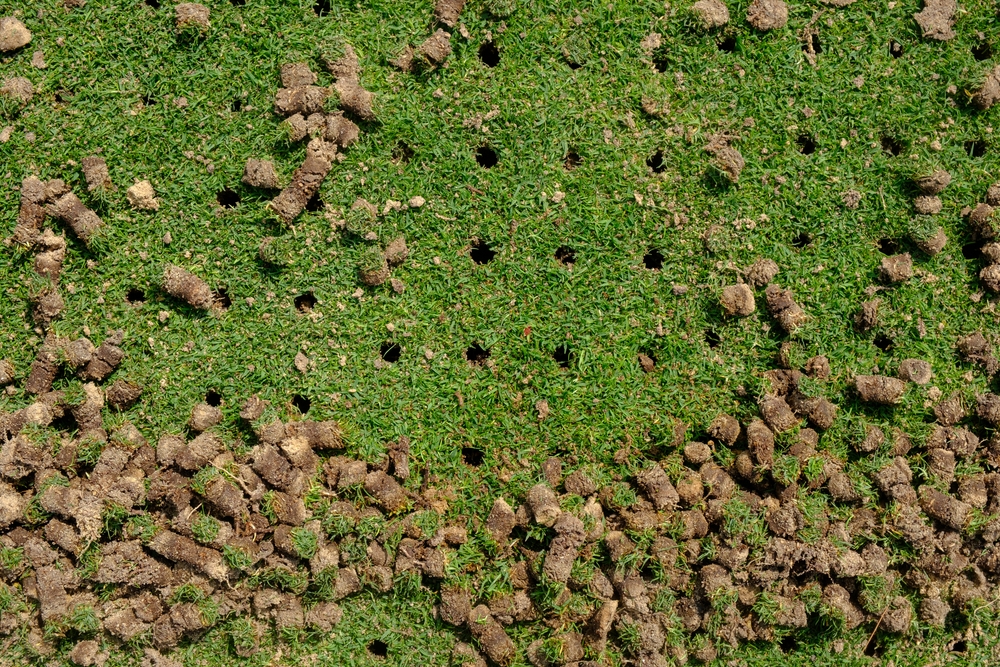
What Is Lawn Aeration?
Lawn aeration is a special treatment to remove and break up compacted soil. This allows oxygen, water, and nutrients to reach the lawn roots, helping to improve your lawn’s health. Aeration is beneficial to your lawn
as it helps promote thicker, greener turf, and stronger root systems. Aeration is recommended for residential and commercial lawns as it improves and promotes turf growth, reduces water runoff, and allows lawns to breathe and absorb vital nutrients.
Many lawn specialists recommend core aeration. This is a specialized lawn care process that uses an aeration machine with metal tines to remove small 1-inch to 3-inch plugs or cores from the soil. This procedure helps promote deeper root growth, drought tolerance, enhances water absorption, and improves a lawn’s turf.
Core aeration also releases compacted soil, reduces thatch buildup, and improves the flow of nutrients, water, and oxygen penetration to the lawn roots. Aeration is generally performed in the early spring or fall when a lawn is growing but not under stress from temperature changes. Lawn aeration is highly recommended for high-traffic lawns or yellowing, thinning, and wilting lawns that do not respond to fertilizer.
What Is Dethatching?
Thatch is a layer of dead organic matter that can include roots, stems, and rhizomes. Thatch accumulates on living grass around its base. Lawn dethatching is a process that removes this dead layer of buildup and helps improve nutrient, water, and oxygen absorption in a lawn. Dethatching helps a lawn to breathe and promotes a healthier, thicker turf, and lawn by promoting root growth.
A lawn should be dethatched only when thatch exceeds ½ inch in depth. This can be seen visually. Dethatching is recommended when the lawn feels very soft or spongy underfoot and appears as a thick, dense mat of brown material. This is unhealthy for the lawn as it prevents water, oxygen, and nutrients from reaching the soil layer and root system. A thin layer of thatch is considered beneficial when it is less than ½ inch in depth.
Identifying excess thatch and knowing how to properly treat and remove it should be left to a professional. When dethatching is done unnecessarily or too aggressively, it can transform a healthy lawn into a severely damaged lawn, causing the lawn to thin, and even die. Thatch buildup occurs most often in Bermuda grass, Zoysia grass, St. Augustine grass, and Kentucky bluegrass.
Aeration vs Dethatching: Key Differences Homeowners Should Know
When to perform an aeration vs dethatching a lawn can be confusing. Dethatching removes dead, decaying surface material, the thatch, to help a lawn breathe by promoting oxygen, water, and nutrients to the roots. Aeration removes and breaks up compacted soil to allow oxygen, water, and nutrients to reach the roots.
Each procedure has a vital function to keep lawns healthy and green. Lawn aeration is generally recommended once or twice a year, depending on the soil conditions, lawn use, and temperature. Lawn dethatching is recommended as needed. This assessment is based on the lawn conditions and thatch accumulation. A thorough inspection is highly recommended.
Signs Your Lawn Needs Aeration or Dethatching
A lawn will show signs when it needs aeration or dethatching. If your grass blades appear yellow, thin, or wilted, it is time for an aeration. If you take a screwdriver or hand weeder and cannot push it in the ground or experience resistance your lawn will benefit from aeration. If your lawn has more than ½ inch covering of brown material, it is time for dethatching. If your lawn is overly brown in places, feels spongy, and has water pooling or runoff, it probably needs a dethatching.
Knowing when to perform lawn aeration or lawn dethatching is often best left to professionals. They can diagnose and access your lawn without harming it and provide answers and a path forward. This is the best course especially when dealing with thatch. If you try to dethatch your own lawn you may do more harm than good by removing too much thatch and destroying the lawn and root system.
Do You Need Aeration, Dethatching, or Both?
Depending on where you live and the condition of your lawn you may need a lawn aeration and a lawn dethatching. The best time to aerate is spring to early fall for cool season grasses, such as Kentucky bluegrass and Fescue, and late spring to early summer for warm-season grasses, such as Bermuda and Zoysia. Your lawn needs to breathe and aeration and dethatching help to promote oxygen flow, nutrients, and water to your lawn’s roots.
If your lawn needs both aeration and dethatching it is recommended to perform a dethatching first, then perform an aeration. Dethatching does not replace aeration or vice versa. Knowing when to aerate, dethatch, or both can be a difficult decision to make. A professional lawn care specialist can help.
Common Mistakes Homeowners Make With Aeration and Dethatching
Mistake #1: Assuming Dethatching Is Always Necessary
Most lawns do not require an annual lawn dethatching as a thin, ½ inch layer of thatch is beneficial to promoting a health lawn. Thatch acts as a mulch, helping the lawn to retain moisture and regulate temperature.
Mistake #2: Dethatching When the Lawn Actually Needs Aeration
If dethatching is done unnecessarily, when the lawn actually needs aeration, or too aggressively, it can transform a healthy lawn into a severely damaged lawn, causing the lawn to thin and even die.
Mistake #3: Over-Aerating or Aerating at the Wrong Time
If you over-aerate or aerate at the wrong time you can stress the lawn and cause it to die. Aerating should not be performed during extreme heat, cold, or when the lawn is dormant.
Mistake #4: DIY Treatments Without Understanding Lawn Conditions
Do it yourself (DIY) treatments are helpful, if you have the knowledge of when to apply them. If you incorrectly apply treatments at the wrong time or too much of an application, you can burn and kill your lawn.
Mistake #5: Treating Symptoms Instead of Underlying Soil or Thatch Issues
Many DIYs try to correct lawn problems themselves without addressing the underlying lawn source.
This can lead to frustration as the problem, such as grubs or soil erosion, will continue to reappear.
The best course of action is to contract a professional lawn specialist.
Choosing the Right Lawn Treatment
Knowing when and how to apply the right lawn treatments at the right time can be a challenge. Soil conditions and local weather affect your lawn. Many times, the best option is to contact a professional lawn specialist to take the guess work out of the equation.
If you have concerns, questions, and reoccurring problems with your lawn care, contact us at Lawn Specialties for help. We are a family owned and operated small business with more than 35 years of experience in providing lawn care solutions to residential and commercial clients in Eastern Pennsylvania and Bergen County, New Jersey. We understand how the harsh Mid-Atlantic winters can take a toll on your lawn and we know how to help. We can access and diagnose your lawn for free, providing you with information on what care your lawn needs so you can make an informed decision. Contact us today for a free estimate.